Best Google Groups Alternatives for Organizations (2026)
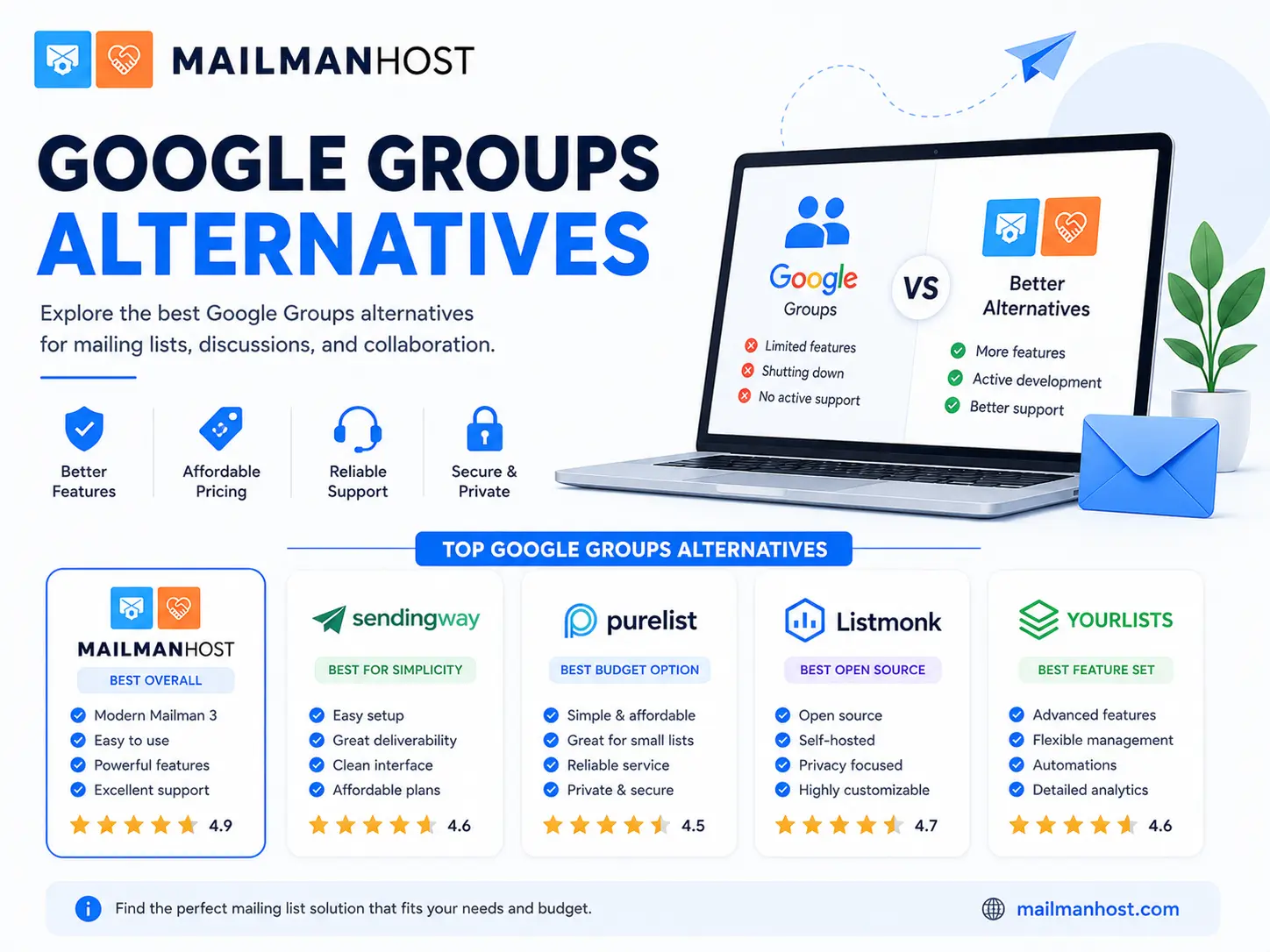
Google Groups has been a default home for email discussion lists for years, but more and more organizations are looking for a way out. Deliverability quirks, a dated interface, uncertainty about the product’s future, and a lack of real control push teams to ask a reasonable question: what is the best Google Groups alternative? This guide compares the leading options and explains why self-managed and managed Mailman hosting is often the strongest long-term answer for organizations that take their lists seriously.
Why organizations leave Google Groups
- Limited control. You cannot fully customize moderation, membership rules, or archive behavior. You get what Google decides to offer.
- Deliverability blind spots. When messages do not arrive, there is little visibility into why, and no support channel to escalate to.
- Data ownership concerns. Your discussion history lives inside Google’s ecosystem, on Google’s terms.
- An aging experience. The interface has seen little meaningful investment, and organizations worry about the long-term commitment behind it.
- Branding and professionalism. A googlegroups.com presence rarely fits an organization that wants its lists to feel like part of its own identity.
The main Google Groups alternatives
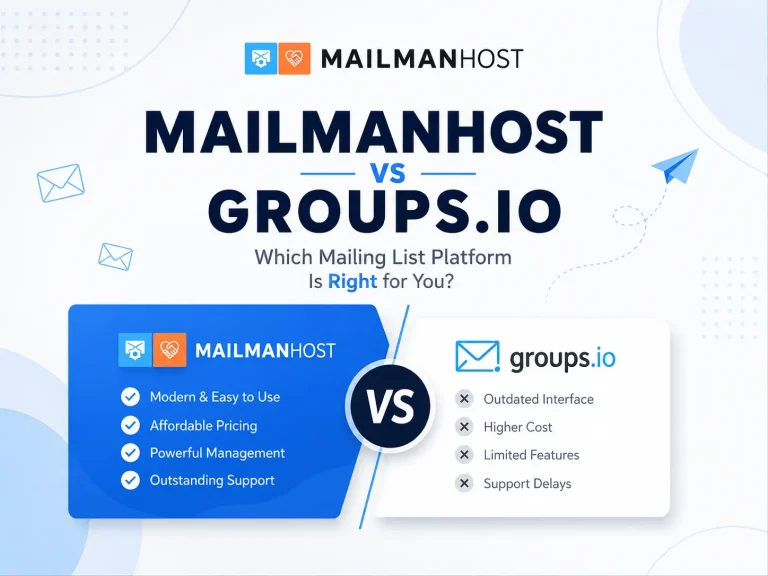
Groups.io
A popular hosted service that modernized the mailing-list experience with integrations, calendars, and a polished interface. It is a solid product, but it is a proprietary platform: you are once again renting space in someone else’s ecosystem, with pricing tiers that gate features and the same fundamental question of data ownership.
Gaggle Mail
A straightforward hosted group-email service aimed at clubs and associations. It is easy to start with, but it is deliberately simple, which means less control over moderation, archives, and advanced deliverability configuration as your needs grow.
listmonk and other self-hosted newsletter tools
Open-source newsletter engines like listmonk are excellent for one-way broadcast email, but they are built for newsletters, not two-way discussion lists. If your members need to reply and converse, a newsletter tool is the wrong shape.
GNU Mailman (self-hosted or managed)
Mailman is the open-source engine that powers a huge portion of the world’s serious discussion lists. It gives you complete control, full data ownership, a searchable archive, and no per-feature paywalls. Mailman 3 in particular pairs a modern admin (Postorius) and a searchable archive (HyperKitty) with a real REST API. The one trade-off is that someone has to run it, which is precisely where managed Mailman hosting comes in.
Why Mailman is the strongest long-term choice
| What matters | Google Groups | Proprietary SaaS | Managed Mailman |
|---|---|---|---|
| Full moderation control | Limited | Partial | Complete |
| Data ownership | Google’s terms | Vendor’s terms | Yours |
| Searchable archive | Basic | Varies | Yes (HyperKitty) |
| Deliverability support | None | Limited | Expert, hands-on |
| Open standards, no lock-in | No | No | Yes |
| Own branding | No | Limited | Yes |
The pattern is clear. Hosted platforms trade control for convenience. Self-hosting Mailman gives you control but hands you the operational burden. Managed Mailman hosting gives you both: the control and data ownership of open-source Mailman, without having to run the servers, patch the software, or fight deliverability battles alone.
Migrating away from Google Groups
Moving off Google Groups is more approachable than most people expect. You export your membership, recreate the list on Mailman, and import your discussion history into the archive. A good managed host handles the mechanics for you, including subscriber import and deliverability setup, so your members barely notice the change beyond a nicer interface.
If you are also weighing which Mailman version to land on, our comparison of Mailman 2 vs Mailman 3 will help, and our migration guide shows how list and archive imports work under the hood.
Making the switch with MailmanHost
At MailmanHost we host GNU Mailman for organizations that want their lists to be reliable, private, and genuinely theirs. You get the modern Affinity admin interface, searchable Empathy archives, expert deliverability support, and fifteen-plus years of Mailman experience behind every list. If Google Groups has run its course for your organization, talk to us or see our plans.
Frequently asked questions
What is the best alternative to Google Groups for organizations?
For organizations that want control, data ownership, and no feature paywalls, managed GNU Mailman hosting is the strongest option. It combines open-source flexibility with expert operational support.
Is Groups.io better than Google Groups?
Groups.io is more modern and feature-rich, but it is still a proprietary platform. You gain polish while keeping the same underlying concerns about lock-in and data ownership.
Can I move my existing Google Groups list to Mailman?
Yes. You export members and history from Google Groups and import them into Mailman. A managed host can run this migration for you so members experience minimal disruption.
Do I need technical skills to switch?
Not with managed hosting. The provider handles installation, migration, deliverability configuration, and maintenance, so you focus on running your community rather than servers.
Ready to own your mailing lists again? Explore MailmanHost plans or start a conversation.